For organisations · turnover & retention
Your good people are leaving. Do you know why?
An exit interview comes too late. The signals are usually there months earlier, but no one can name them. The me.scan makes visible which work consistently drains energy – including for people who perform well.

Sound familiar?
Where things usually get stuck
The wrong people leave
It’s precisely the people you wanted to keep who walk away – not the weakest performers.
The exit interview tells you nothing
“A new challenge” is the most common answer. There’s nothing you can do with that.
Replacing costs more than you think
Recruitment, onboarding time and lost knowledge quickly add up to a year’s salary.
What it delivers
What the me.scan adds here
- Early signals
Fragile strength shows which behaviour someone is good at but which consistently exhausts them. That is the silent predictor of departure.
- Focused conversations
You know what the conversation should be about, instead of fishing for what’s going on.
- Adjusting roles
Often someone doesn’t need to leave – the role needs to change. Job crafting based on talent instead of gut feeling.
From the report · Load level
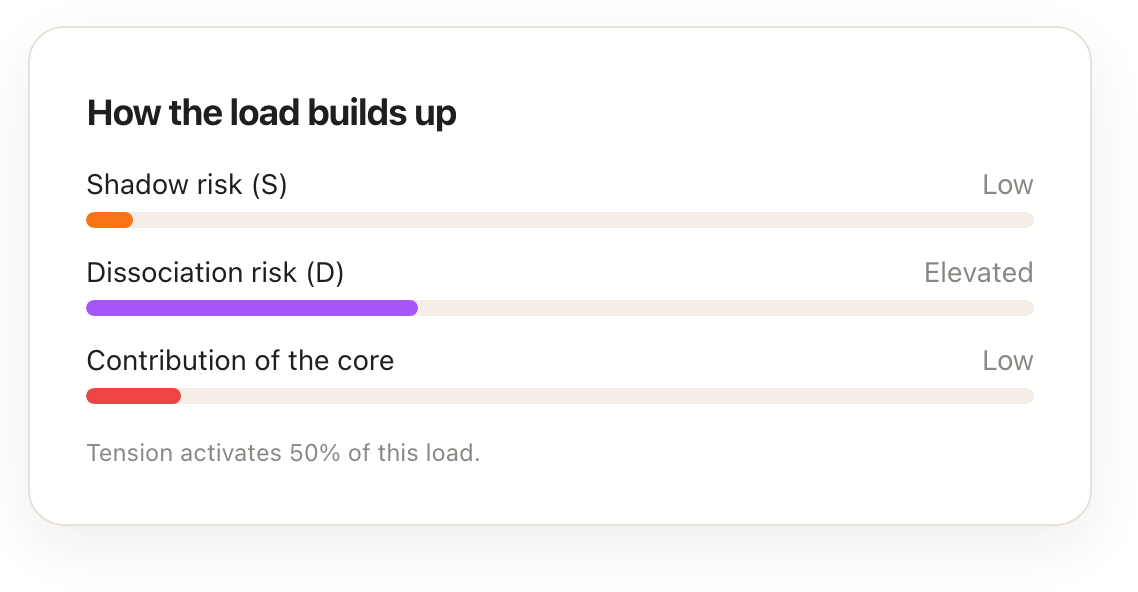
Where the load comes from, broken down into shadow risk, dissociation risk and the contribution of the core.
In short
What this means in practice
Signals before the exit interview
Fragile strength becomes visible at the moment of measurement, not once someone has already resigned.
Knowing what the conversation should be about
Insight per employee, not a generic satisfaction survey.
Adjusting the role instead of replacing
An adjustment in tasks is cheaper than a new recruitment round.
Next step
See what this means for your organisation
In an introduction we show you how this works with the profiles of your own people – aggregated, never traceable to individuals.